
When people talk about building wealth, one number seems to dominate almost every conversation:
Rate of return.
How much can I earn in the stock market?
Should I expect 7%, 8%, 10%, or even 12%?
Can I find an investment that earns just another 1% or 2%?
There is nothing wrong with wanting a good return on your money. Rate of return absolutely matters.
But I think we often make the mistake of treating it as though it is the determining factor in whether someone becomes wealthy.
It isn’t.
In fact, for many people—especially during the wealth accumulation phase of their lives—there are several financial variables they have far more control over that may ultimately have a much greater impact on their financial future.
Your Return Only Applies to the Money You Actually Save
Consider two people.
One person makes $100,000 per year and manages to save $5,000.
Another person makes the same $100,000 but saves $20,000.
Now imagine the first person is an outstanding investor and earns a 10% return, while the second person earns only 7%.
On the first person’s $5,000 of annual savings, a 10% return produces $500 during that first year.
The second person’s $20,000 earning only 7% produces $1,400.
The person earning the lower rate of return still created substantially more wealth.
Why?
Because the amount of capital being put to work matters enormously.
This is one reason I believe people sometimes spend too much time trying to optimize the return side of the wealth equation while ignoring everything that happens before their money ever gets invested.
Before asking:
“How do I earn another 1%?”
It may be far more valuable to ask:
“How do I get another $5,000, $10,000, or $20,000 working for me every year?”
That is a very different financial question.
Savings Rate Can Be More Powerful Than Investment Return
One of the foundational lessons we teach in The Richest Boy in Athens is to pay yourself first.
In other words, when income comes in, some portion of that income should belong to your future self before everyone else gets paid.
Your mortgage company gets paid.
The grocery store gets paid.
The electric company gets paid.
Amazon gets paid.
Restaurants get paid.
Your streaming services get paid.
Everyone seems to get paid.
But did you?
If you simply spend throughout the month and plan to save whatever remains, there frequently isn’t much remaining.
Instead, reverse the process.
Income → Save → Spend
rather than:
Income → Spend → Hopefully Save
This seemingly simple behavioral change can have an enormous effect over several decades.
And unlike the return generated by the stock market next year, your savings behavior is something you have considerably more control over.
Cash Flow Is One of Your Greatest Wealth-Building Tools
There is another side to this equation that gets surprisingly little attention:
cash flow.
Think of your household as a business.
Money flows in.
Money flows out.
Whatever remains can be accumulated, invested, or used to acquire assets.
That means increasing the gap between income and consumption creates capital.
You can accomplish that from either direction:
- Increase your income.
- Reduce unnecessary spending.
- Eliminate inefficient debt.
- Reduce financial fees.
- Manage taxes intelligently.
- Avoid lifestyle inflation.
- Build additional sources of income.
Suppose you have $100,000 invested.
Finding a way to increase your return from 7% to 8% potentially creates another $1,000 during the first year.
That’s great.
But imagine instead that you find $500 per month of additional cash flow through increased income, lower expenses, eliminating unnecessary interest, or some combination of the three.
That’s $6,000 of additional capital every year.
And now that additional $6,000 gets to earn returns too.
This is why wealth building shouldn’t be viewed simply as an investment problem.
It is a capital accumulation problem first.
Don’t Confuse Average Returns With the Returns You Actually Earn
There is another problem with obsessing over investment returns: the number advertised or discussed isn’t necessarily the number you personally experience.
I’ve written previously about the difference between average stock market returns and the compound return an investor actually earns.
A portfolio experiencing:
+20%
followed by:
-20%
did not break even.
If you begin with $100, a 20% gain takes you to $120.
A subsequent 20% loss reduces $120 to $96.
Your average annual return was technically 0%, yet you lost 4% of your money.
Volatility matters.
Timing matters.
Taxes matter.
Fees matter.
Investor behavior matters.
The sequence in which returns occur can matter tremendously—particularly when someone begins withdrawing money during retirement.
So even when discussing “rate of return,” we have to ask:
Which return?
Average return?
Compound annual growth rate?
Return before fees?
Return after fees?
Return before taxes?
Return after taxes?
Nominal return?
Inflation-adjusted return?
There is a huge difference between a number shown on a chart and the return that eventually increases your usable wealth.
A Dollar You Don’t Lose Can Be as Valuable as a Dollar You Earn
People naturally focus on upside.
How much can I make?
But sound financial planning also requires considering what financial economists might describe as leakage.
Money can leave your personal financial system through:
- Taxes
- Interest
- Investment fees
- Insurance costs
- Poorly structured debt
- Unnecessary consumption
- Inflation
- Financial mistakes
- Market losses
- Opportunity costs
Imagine working incredibly hard to squeeze another 1% out of your investment portfolio while simultaneously sending thousands of dollars unnecessarily out of your financial system every year.
That is financial optimization in the wrong order.
Before attempting to maximize the return on every dollar, it makes sense to ask how many of your dollars you are actually keeping.
Financial Efficiency Matters
This brings us to a concept that I think deserves much more attention:
financial efficiency.
Suppose two households each earn $150,000.
Household A manages to retain and deploy $10,000 annually.
Household B manages to retain and deploy $30,000.
Even if Household A gets a somewhat higher investment return, Household B has an enormous advantage.
They simply have more capital working for them.
And if that extra capital compounds over 20, 30, or 40 years, the difference can become enormous.
This is why I like thinking of personal finance as a system, rather than a collection of unrelated accounts.
Your income, savings, debt, taxes, insurance, investments, liquidity, and spending all interact.
The goal shouldn’t necessarily be to maximize one variable.
The goal should be to build the most efficient financial system possible.
Rate of Return Still Matters
None of this means that investment returns are irrelevant.
Far from it.
If you could safely and consistently earn 10% instead of 5% for several decades, the difference would be enormous because of compounding.
The point is simply that return is one variable among many.
And chasing higher returns generally means accepting something else in exchange.
Usually:
Risk.
Sometimes:
Liquidity.
Sometimes:
Control.
Sometimes:
Volatility.
And sometimes several of those things simultaneously.
Instead of simply asking which investment has the highest expected return, a better question is:
What job is this money supposed to perform?
Money you might need next month has a different job than money you’re investing for 30 years.
Emergency reserves have a different job than retirement assets.
Money intended to purchase a business has a different job than money designated for speculation.
Your financial assets don’t all need to compete for the highest return because they don’t all have the same purpose.
Building Wealth Is About More Than Picking Investments
This is perhaps the biggest lesson.
Building wealth is not synonymous with investing.
Investing is one component of wealth building.
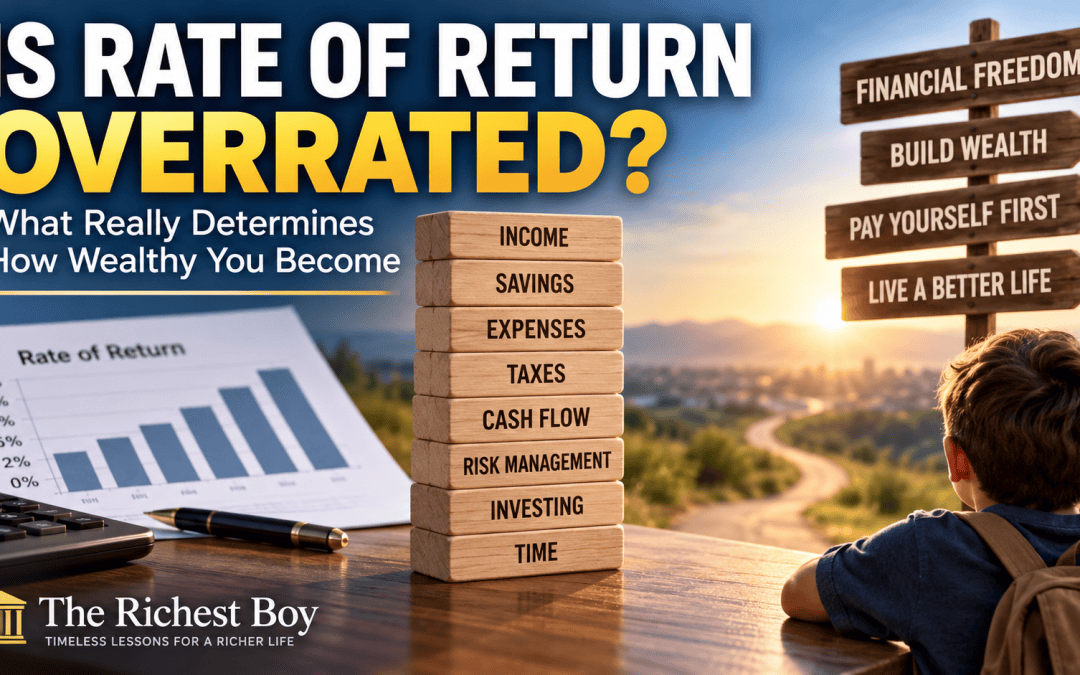
A person’s financial outcome is influenced by:
1. How much they earn
Creating more value and developing skills can dramatically increase your ability to accumulate capital.
2. How much they save
You cannot invest money you consume.
3. How early they begin
Compounding becomes incredibly powerful when you give it decades to work.
4. How efficiently they manage their finances
Taxes, interest, fees, insurance, and other financial costs all matter.
5. How they manage risk
One catastrophic financial event can undo decades of otherwise good financial decisions.
6. How they invest
Yes—rate of return belongs here too.
7. How they behave
Perhaps most importantly, none of the mathematical models matter if human behavior prevents someone from following them.
Fear.
Greed.
Lifestyle inflation.
Panic selling.
Excessive debt.
Chasing the latest investment.
Trying to get rich quickly.
These behavioral mistakes can overwhelm the difference between earning 7% and earning 8%.
Teach This Lesson to Your Children Early
This is one of the reasons I am so passionate about teaching financial literacy to children.
Imagine two children.
One grows up believing wealth comes primarily from finding the investment with the highest return.
The other learns that wealth starts with:
Producing value.
Earning.
Paying yourself first.
Delaying gratification.
Accumulating capital.
Investing intelligently.
Protecting what you’ve built.
Allowing time and compounding to work.
Which child has the better financial foundation?
This is exactly why I created The Richest Boy in Athens series.
Through Kap’s adventures in Ancient Athens, children learn financial principles like earning money by creating value, paying themselves first, delayed gratification, saving, investing, entrepreneurship, and making thoughtful financial decisions.
The objective isn’t to turn an eight-year-old into a stock analyst.
It’s to develop the habits and way of thinking that make good financial decisions much more likely for the rest of their life.
[Learn more about The Richest Boy in Athens book series]
Focus on What You Can Control
Financial markets are inherently uncertain.
You don’t know exactly what the S&P 500 will return next year.
Neither do I.
Neither does anyone else.
But there are plenty of financial variables you can influence.
You can improve your skills.
You can increase your income.
You can pay yourself first.
You can control consumption.
You can reduce unnecessary debt.
You can accumulate liquidity.
You can understand where your money is going.
You can protect your family against catastrophic risks.
You can invest consistently.
And you can give your money time to compound.
These things might not make for exciting financial headlines.
Nobody goes viral saying:
“Save more money consistently for 30 years.”
But boring financial principles tend to endure precisely because they work.
The Bottom Line
So, is rate of return overrated?
Sometimes, yes.
Not because return isn’t important, but because we frequently place far too much emphasis on it relative to everything else that determines financial success.
A 1% higher investment return can certainly help.
But increasing the amount of money you save by 50%, dramatically increasing your income, reducing major financial leakage, avoiding catastrophic losses, and keeping more of your money working for you may matter substantially more.
Build the capital first.
Protect it.
Deploy it intelligently.
Improve the efficiency of your financial system.
And then allow compounding to do what it does best:
Give time the opportunity to turn relatively small financial decisions into very large results.
Want to Go Deeper?
Watch the Video:
Prefer video? Watch “Is Rate of Return Overrated?” on The Richest Boy YouTube channel.
Teach These Principles to Your Children:
The Richest Boy in Athens series teaches children ages 6–12 fundamental financial principles through stories and adventures rather than lectures.
Learn More About Building Your Financial System:
If you’re interested in learning how I personally think about savings, liquidity, life insurance, Infinite Banking, protecting your family, or improving the efficiency of your financial system, explore the personal finance resources on The Richest Boy website.
Want Help With Your Own Financial Protection Strategy?
I also work with individuals, families, and business owners on life insurance, income protection, retirement income, and properly designed high-cash-value whole life strategies. If you’d like to review your current situation and see whether there are gaps or opportunities for improvement, reach out to schedule a conversation.
This article is for educational purposes only and should not be considered individualized investment, tax, legal, or insurance advice.